The deliverability tooling market is fragmented by design. Each tool was built to solve a specific, bounded problem.
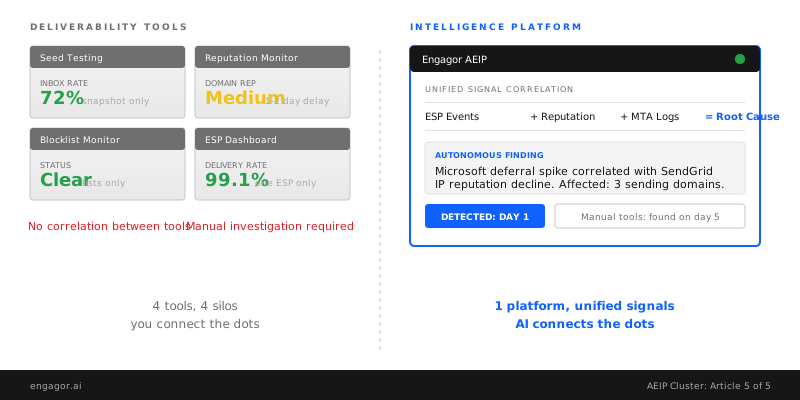
Consider what this looks like in practice for a SaaS company sending across three ESPs: transactional through Postmark, marketing through Brevo, and product notifications through SendGrid. When inbox placement at Microsoft drops 15% over two weeks, the team checks each ESP dashboard separately. All three show clean delivery rates. They run a GlockApps test, which shows a Microsoft spam placement issue but no indication of which ESP or sending domain is causing it. They check Postmaster Tools, which covers Gmail only. They check SNDS, which shows a reputation decline on one IP range registered to their SendGrid account. The answer was in SNDS, but finding it required manually checking five separate systems.
That is the problem this article is about. Seed testing tools check inbox placement. Reputation monitoring tools track domain and IP health. Blocklist monitors check whether your infrastructure appears on known block lists. Authentication validators confirm DNS configuration.
Each of these tools does what it was designed to do. None of them was designed to work together. And none of them was designed for the question that matters most to a deliverability team managing email at scale: what is happening across my entire sending environment right now, and what should I do about it?
This article describes the taxonomy of deliverability tools, what each category does well and where each stops, and what distinguishes a deliverability intelligence platform from the individual tools that precede it.
The deliverability tool taxonomy
Pre-send testing tools
Tools in this category analyze a message or a sending configuration before sending occurs. GlockApps is the most widely used example. You submit a test message, and the tool delivers it to a panel of seed addresses across multiple mailbox providers and reports where it landed: inbox, spam, or promotions tab.
What they do well: pre-send testing identifies content or configuration issues before they affect real recipients. A test that shows 40% spam placement at Gmail before a campaign sends gives you the opportunity to change something. That is genuinely valuable.
What they do not do: pre-send testing tells you nothing about what is happening with your live traffic. The seed accounts used for testing have different engagement histories than your real subscriber base. Inbox placement for a test message is not reliably predictive of inbox placement for a campaign to your actual subscriber list, because seed account engagement histories differ from real subscriber behavior. Pre-send testing is, however, reliable for detecting authentication failures and gross content filtering issues before they affect live recipients. And pre-send testing is, by definition, manual and episodic: you run a test when you remember to, not continuously.
Reputation monitoring tools
Tools in this category track reputation signals from mailbox providers and third-party sources. Google Postmaster Tools is the most important free example. Validity Everest is the most comprehensive paid example. Microsoft SNDS provides IP-level reputation data for Outlook traffic.
What they do well: reputation monitoring gives you visibility into how mailbox providers perceive your sending infrastructure. Postmaster Tools spam rate data is the clearest available signal of Gmail complaint levels. SNDS spam trap data is the clearest signal of list quality problems affecting Microsoft deliverability.
What they do not do: reputation monitoring tools report on reputation, not on delivery events. They do not tell you what is happening in your ESP event stream. They do not correlate reputation shifts with specific sending segments, campaigns, or list changes. They report with delay. And they cover a limited set of providers: Postmaster Tools covers Gmail, SNDS covers Microsoft, and coverage for other providers is patchwork.
Blocklist monitors
Tools in this category check whether sending IPs or domains appear on known blocklists. MXToolbox is the most widely used example. Commercial monitoring services check against a larger number of lists on a more frequent schedule.
What they do well: blocklist monitoring catches the specific scenario in which an IP or domain has been listed, which produces delivery failures at any receiving server that uses that blocklist for filtering.
What they do not do: most delivery failures are not caused by blocklist hits. Reputation-based filtering at Gmail and Microsoft operates through proprietary systems that are not reflected in public blocklists. A sender who is not on any public blocklist can still have severe deliverability problems at the major mailbox providers. Blocklist monitoring is necessary but not sufficient.
ESP dashboards
Every cloud ESP provides a dashboard that shows delivery status for messages sent through that platform. SendGrid, Brevo, Mailgun, Klaviyo, and others all have reporting interfaces that show delivered, bounced, opened, and clicked metrics.
What they do well: ESP dashboards give you real-time visibility into delivery outcomes for traffic through that platform. They are the fastest way to see if something has changed in delivery rates.
What they do not do: ESP dashboards cover only one ESP. They show delivery outcomes without explaining causes. They do not correlate delivery events with reputation signals, MTA behavior, or activity at other sending systems. They do not provide cross-ESP visibility for organizations sending through multiple platforms.
The pattern across all tool categories
Every category of deliverability tool shares a structural characteristic: it answers one type of question, about one source of data, when you ask it.
Pre-send testing answers: does my test message land in the inbox right now, at these seed addresses?
Reputation monitoring answers: what does this provider's dashboard say about my domain or IP reputation today?
Blocklist monitoring answers: does my IP or domain appear on this list right now?
ESP dashboards answer: what happened to the messages I sent through this platform?
None of them answers the question that most matters for a team managing deliverability at scale: across all of my sending infrastructure, what patterns are emerging, and what do they indicate about problems that are developing?
Answering that question requires combining data from all of these sources, in real time, continuously, and looking for correlations across them. That is not a capability that exists in any individual tool. It requires a different category of system.
What a deliverability intelligence platform does differently
The distinction between a deliverability tool and a deliverability intelligence platform is not about features. It is about architecture and orientation.
Deliverability tools are passive and query-driven. They have data. They return answers when asked. The user decides what to ask and when to ask it.
A deliverability intelligence platform is active and continuous. It ingests signals from multiple sources, normalizes them into a unified data model, monitors them without interruption, and surfaces findings when they emerge, regardless of whether a user initiated a query.
The practical consequence is a difference in what gets found. A system that requires a user to initiate a query will find the problems the user thought to look for. A system that monitors continuously and surfaces anomalies proactively will find problems that no one thought to look for, often before they have caused significant damage.
The second structural difference is in the cross-source correlation. A reputation shift in Postmaster Tools that occurs at the same time as a deferral rate increase in MTA logs and a complaint rate increase in the ESP dashboard is almost certainly a single developing problem viewed from three different angles. A system that treats these three signals as independent events from three different tools will surface them as three separate observations. A system that correlates them will surface them as a single finding with a coherent explanation.
For the teams managing email at the volumes and complexity levels where deliverability problems have material business impact, the difference between these two architectures is the difference between finding out about a problem on day one and finding out on day five.
When simpler tools are sufficient
This distinction matters most at scale and complexity. For smaller senders with straightforward sending environments, individual tools are often sufficient.
A company sending through a single ESP to a clean, opted-in list of under a million subscribers per month can manage deliverability effectively with ESP dashboards, occasional pre-send testing, and periodic checks of reputation tools. The fragmentation problem is manageable at this scale because there are fewer sources to monitor and the relationships between them are simpler.
The architecture described above becomes necessary when the combination of sending volume, sending complexity, and business sensitivity to deliverability issues exceeds what periodic manual monitoring can reliably catch. The inflection point is different for every organization. Common indicators that it has been reached include: deliverability problems that were not caught until they had caused significant damage, regular manual work to correlate data across multiple tools, and an inability to confidently answer the question of what is happening across all sending infrastructure right now.
The category name
Practitioners in the space are increasingly using the term Agentic Email Intelligence Platform, or AEIP, to describe this category of system. The term captures two characteristics that distinguish it from individual tools: the agentic behavior of continuous autonomous monitoring without user-initiated queries, and the intelligence layer that makes cross-source correlation and pattern recognition actionable rather than merely possible.
Engagor is built as an AEIP. It ingests raw delivery events from ESPs and MTAs, normalizes them into a unified ClickHouse data layer, correlates them continuously with reputation signals from Google Postmaster Tools and Microsoft SNDS, and surfaces findings without requiring a user to initiate a query. The architecture is designed specifically for the multi-ESP, multi-domain environment where the fragmentation described in this article makes manual monitoring unreliable at scale. If you are evaluating whether this category of system applies to your environment, the platform overview describes the specifics of how Engagor implements it.
Continue reading
This article is part of a five-part series on email deliverability intelligence.
- AI for Email Deliverability: What It Can Actually Do (and What It Can't)
- Why Email Deliverability Monitoring Breaks at Scale
- The Hidden Signals: What Deferrals, Retries, and Throttling Actually Tell You
- How Enterprise Email Teams Actually Diagnose Deliverability Problems
Frequently asked questions
What is the difference between a deliverability tool and a deliverability intelligence platform?
Deliverability tools are query-driven: they answer specific questions about specific data sources when a user asks them. A deliverability intelligence platform is continuous and proactive: it ingests signals from multiple sources, monitors them without interruption, and surfaces findings autonomously. The practical difference is in what gets detected. Query-driven tools find problems that users thought to look for. A continuous intelligence platform can find problems that no one thought to look for, often before they have caused significant impact.
What tools do email deliverability teams use?
Most deliverability teams use a combination of: pre-send testing tools like GlockApps for inbox placement checks, reputation monitoring tools like Google Postmaster Tools and Microsoft SNDS for provider-level reputation signals, blocklist monitors like MXToolbox for IP and domain blocklist status, and ESP dashboards for delivery outcome data. Each tool provides a slice of the picture. None provides an integrated view across all sources.
What is an Agentic Email Intelligence Platform?
An Agentic Email Intelligence Platform, or AEIP, is a system that ingests deliverability signals from ESP event streams, MTA logs, and mailbox provider telemetry, normalizes them into a unified data model, and monitors them continuously without requiring user-initiated queries. When correlated patterns emerge across sources, the system surfaces a structured finding with context, rather than firing an isolated threshold alert. Learn more about AEIP.
When do I need a deliverability intelligence platform instead of individual tools?
Individual tools are sufficient for smaller senders with straightforward sending environments. The architecture of a deliverability intelligence platform becomes necessary when the combination of sending volume, sending complexity, and business sensitivity to deliverability problems exceeds what periodic manual monitoring can reliably catch. Common indicators include deliverability problems not caught until they caused significant damage, regular manual work correlating data across multiple tools, and inability to confidently describe what is happening across all sending infrastructure in real time.