Most deliverability monitoring focuses on the signals that are easiest to see: bounce rate, open rate, spam complaint rate. These metrics matter. But by the time they move significantly, the underlying problem has usually been building for days.
There is a category of signals that appear earlier, are more granular, and are more diagnostic than any of the standard metrics. Deferrals, retry patterns, and throttling behavior sit at the SMTP layer, and they carry information about what receiving mail servers think of your sending infrastructure before that judgment surfaces in the metrics your dashboard reports.
This article explains what these signals are, how to read them, and why they are systematically underrepresented in standard deliverability monitoring.
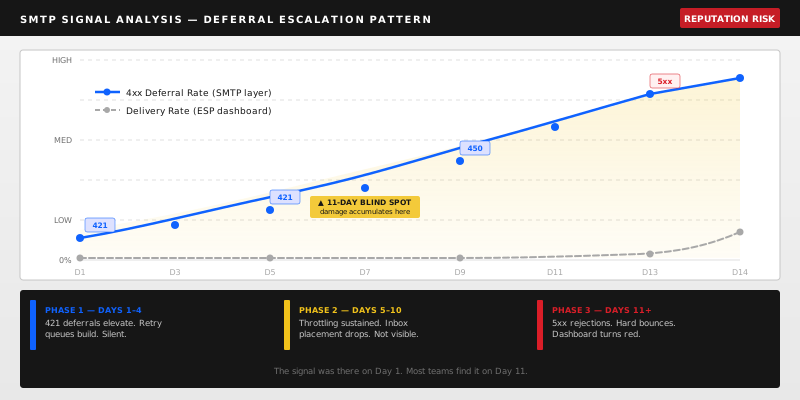
A concrete example of what this looks like in practice: an online retailer running high-volume campaigns through a cloud ESP notices that Gmail open rates have dropped 12% over two weeks. The ESP dashboard shows a delivery rate above 99% throughout the period. When a deliverability engineer finally pulls MTA-level data, they find that 421 deferral rates at Gmail have been elevated for 11 of those 14 days, with a pattern consistent with reputation-based throttling. The messages were eventually delivered after extended retries, so the delivery rate metric stayed clean. But the throttling was visible in the retry queue data for nearly two weeks before anyone looked. The inbox placement damage accumulated throughout.
What a deferral actually is
When a sending mail server attempts to deliver a message, the receiving server responds with one of three outcomes. It accepts the message (a 2xx response). It permanently rejects it (a 5xx response, which generates a hard bounce). Or it temporarily declines to accept it and asks the sending server to try again later. That third outcome is a deferral, indicated by a 4xx SMTP response code.
Deferrals are a normal part of email infrastructure. Receiving servers defer messages for reasons that have nothing to do with sender reputation: temporary overload, maintenance windows, greylisting for new senders, and transient network issues all produce 4xx responses. A deferral rate of a fraction of a percent on any given sending session is expected.
What makes deferrals diagnostic is their pattern, not their presence. The specific 4xx code, the response message text, the volume of deferrals as a proportion of total delivery attempts, the duration over which deferrals persist before resolving, and the specific IP addresses and domains generating them all carry information that standard bounce reporting does not capture.
The SMTP codes that matter
Not all 4xx responses are equivalent. The code and the accompanying message text carry specific meaning.
421 is a service temporarily unavailable response. At low rates, it typically indicates transient load on the receiving server. At elevated rates concentrated on specific receiving domains, it indicates that the receiving server is deprioritizing or throttling traffic from the sending IP or domain. Microsoft's infrastructure uses 421 responses extensively as a throttling mechanism before escalating to reputation-based blocks.
450 indicates that the mailbox is unavailable. This can indicate a full mailbox on the recipient side, which is not a sender problem. It can also indicate IP-level reputation filtering at certain receiving servers, depending on the accompanying message text.
451 is a processing error or temporary failure on the receiving side. Certain implementations use 451 with specific message text to indicate content filtering or spam detection without issuing a permanent rejection. Postfix installations commonly return 451 responses for greylisting.
452 indicates insufficient system storage. This is typically a transient receiving-server issue and is not diagnostic of sender behavior unless it appears in unusual volume.
The message text accompanying the code often provides more information than the code itself. A 421 from Microsoft with the text "Service temporarily unavailable. Please try again later" in the context of normal sending volume is different from the same code appearing alongside text that references sending limits, policy violations, or reputation thresholds.
What throttling looks like in practice
Throttling is the mechanism by which receiving mail servers limit the rate at which they accept messages from a given source. It is a deliberate tool used by mailbox providers to manage inbound volume and to apply pressure to senders whose traffic is consuming disproportionate resources relative to its value to recipients.
Throttling manifests as a sustained pattern of 421 deferrals, sometimes accompanied by reduced connection acceptance rates. The sending MTA continues to attempt delivery. The receiving server continues to defer. Messages accumulate in the retry queue. Delivery is eventually completed, but with significant latency.
The key diagnostic insight is that throttling at a meaningful rate is rarely a neutral technical event. Mailbox providers, particularly Gmail and Microsoft, apply throttling based on a combination of volume, velocity, and reputation signals. A sender who suddenly experiences throttling at Gmail after months of clean delivery has almost certainly triggered a reputation signal that has not yet surfaced in Postmaster Tools data.
This is the early warning property of deferral monitoring. The throttling signal appears before the reputation metric moves, because the reputation metric is reported with delay while the deferral is visible in MTA logs in real time.
Retry queue behavior as a diagnostic signal
When messages are deferred, the sending MTA places them in a retry queue and attempts redelivery at intervals. The behavior of that retry queue tells you things that the deferral rate alone does not.
Under normal conditions, a queue of deferred messages drains steadily as retry attempts succeed. The ratio of successful retries to total retry attempts should be high, and the age of messages in the queue should be low.
When something is genuinely wrong, the retry queue behaves differently. Messages accumulate faster than they drain. The average message age in the queue increases. Retry attempts fail at rates that indicate the receiving server is not simply experiencing transient load but is actively deprioritizing traffic from the sender.
For organizations operating PowerMTA, GreenArrow, or similar enterprise MTAs, queue monitoring is a native capability. PowerMTA's accounting files record delivery attempts, response codes, and retry history at the message level. GreenArrow's dashboard exposes queue depth and retry metrics in real time. The data is available. What it requires is a team or system that is watching it continuously, not sampling it periodically.
Cloud ESPs typically abstract away retry queue behavior. SendGrid, Brevo, and Mailgun handle retries internally and surface only the final delivery status in their event streams. This is operationally convenient but removes visibility into the retry behavior that would otherwise be diagnostic.
The escalation pattern
Deliverability problems that originate in reputation typically follow a sequence that is visible in deferral data before it surfaces in delivery rates.
The sequence begins with an increase in deferral rate at a specific receiving domain. The deferrals are accompanied by response codes and message text that suggest reputation-based throttling rather than transient load. Retry success rates decline. Queue depth increases. Over a period that might be hours or days depending on the severity, the deferral pattern stabilizes into a sustained state where a meaningful proportion of messages to that receiving domain are not completing delivery within normal timeframes.
At this stage, inbox placement at the affected provider is declining. But because cloud ESPs report delivery status, not inbox placement, the effect is often not yet visible in the dashboard. Messages that complete delivery after extended retries are counted as delivered. The delivery rate metric does not reflect the latency, and it does not reflect the spam folder placement that may be accompanying the throttled delivery.
Eventually, if the underlying reputation issue is not addressed, the pattern escalates further. Temporary deferrals give way to permanent rejections. Hard bounce rates increase. The dashboard turns red. The problem that was visible in deferral patterns days or weeks earlier is now unambiguous, and the remediation timeline has lengthened accordingly.
Why most teams miss this
There are three structural reasons why deferral-level signals are systematically underrepresented in standard deliverability monitoring.
First, cloud ESPs abstract them away. The retry logic in SendGrid, Brevo, and similar platforms is internal. The event stream exposed to customers shows delivery outcomes, not delivery process. A message that was deferred twelve times over four hours before finally delivering appears in the webhook as a single delivery event with no indication of the journey it took.
Second, MTA-level data requires infrastructure access. Organizations running PowerMTA or GreenArrow have access to SMTP-level detail, but that data lives in accounting files and database tables that are not connected to ESP dashboards. Bridging them requires custom integration work.
Third, pattern analysis across time is harder than threshold alerting. A single deferral is meaningless. A 3% increase in deferral rate at Gmail over 48 hours, concentrated on one sending subdomain, is significant. Identifying the second scenario requires tracking deferral rates over time by provider, by sending domain, and by IP, then comparing the current state to a baseline. That is not a query that standard tools run automatically.
This is precisely the type of signal that benefits most from continuous, cross-source monitoring — the architecture described in why multi-ESP monitoring breaks at scale and in how enterprise email teams actually diagnose deliverability problems. The value of automated deferral monitoring is not in alerting on individual events. It is in detecting the pattern that precedes a reputation escalation before the escalation is visible in standard metrics.
Continue reading
This article is part of a five-part series on email deliverability intelligence.
- Part 1: How Enterprise Email Teams Actually Diagnose Deliverability Problems
- Part 2: Why Email Deliverability Monitoring Breaks at Scale
- Part 3: The Hidden Signals: What Deferrals, Retries, and Throttling Actually Tell You (this article)
- Part 4: AI for Email Deliverability: What It Can Actually Do (and What It Can't) — coming soon
- Part 5: Deliverability Tool vs Deliverability Intelligence Platform: What's the Difference? — coming soon
Frequently asked questions
What is a deferral in email delivery? A deferral is a temporary rejection of a delivery attempt, indicated by a 4xx SMTP response code. The receiving server accepts the connection but declines to accept the message, asking the sending server to retry later. Deferrals are a normal part of email infrastructure at low rates. At elevated rates or in sustained patterns, they indicate reputation-based throttling, volume limits, or infrastructure issues at the receiving domain.
How is a deferral different from a bounce? A bounce is a permanent rejection, indicated by a 5xx SMTP response code. The receiving server will not accept the message, and no further delivery attempts will succeed. A deferral is temporary: the sending server will retry, and delivery may eventually succeed. The practical distinction matters for diagnosis: a bounce indicates a definitive problem with a recipient address or a permanent policy decision, while a deferral indicates a transient condition that may resolve on its own or may be an early indicator of a developing reputation problem.
What does it mean when Gmail or Microsoft starts throttling my email? Throttling means the receiving server is rate-limiting delivery attempts from your sending infrastructure. At Gmail and Microsoft, throttling is applied based on a combination of sending volume, sending velocity, and reputation signals. Sustained throttling at a provider where delivery was previously clean is typically an early indicator that reputation signals have shifted. It appears in MTA logs as elevated 421 response rates before it surfaces in reputation monitoring tools, which report with a one-to-two day delay.
What is an Agentic Email Intelligence Platform? An Agentic Email Intelligence Platform, or AEIP, treats deferral patterns as first-class signals alongside delivery rates, reputation scores, and complaint data. Rather than requiring a practitioner to pull MTA logs and correlate them manually with provider reputation data, an AEIP ingests both continuously and surfaces deferral anomalies in the context of the other signals they correlate with. The result is that throttling patterns become visible as they develop, not after they have caused inbox placement damage that took days to accumulate.
Engagor monitors SMTP-layer signals continuously across your sending infrastructure — surfacing deferral patterns, retry anomalies, and throttling trends before they escalate into dashboard crises.