AI is being attached to every product category right now. Email deliverability is no exception. But most of what's marketed as "AI-powered deliverability" is one of two things: a rule engine with a modern label, or a content scoring tool that checks subject lines for spam trigger words.
Neither of those is what serious deliverability teams need.
This article explains what AI can genuinely do for email deliverability, where it fails, and what the architecture looks like when it's done properly. No hype, no vendor positioning disguised as analysis.
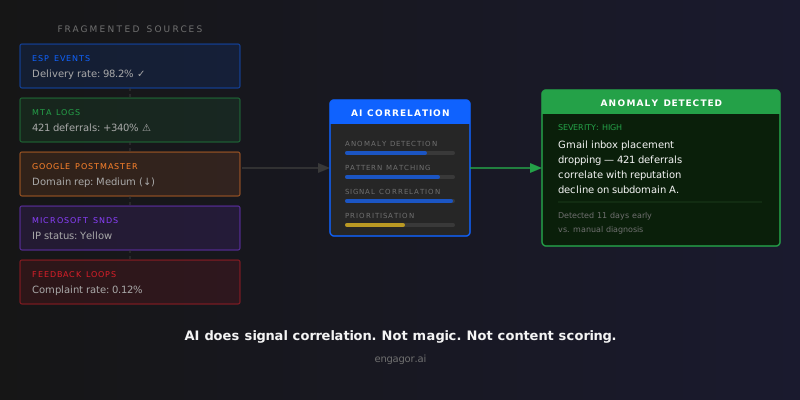
Consider this scenario: a retail company sending 15 million messages a month across SendGrid and Klaviyo notices a gradual open rate decline over three weeks. The ESP dashboards show clean delivery rates throughout. When the team finally investigates, they find that Gmail inbox placement has dropped 18 percentage points, driven by a complaint rate increase in one sending subdomain that no dashboard surfaced automatically. The signal was there in Google Postmaster Tools, but nobody was watching it in the context of the delivery event data. An anomaly detection system watching both sources simultaneously would have flagged the divergence in week one, not week three.
What deliverability teams actually deal with
Before evaluating what AI can do, it helps to understand what the problem actually is.
A deliverability team managing email at scale is dealing with signals from multiple sources simultaneously. An ESP like SendGrid or Brevo reports delivery status per message. Google Postmaster Tools reports domain reputation and spam rates, but only for Gmail traffic, only at the domain level, and with a delay. Microsoft's SNDS (Smart Network Data Services) reports IP reputation and spam trap hits for Outlook traffic, but on a different schedule and in a different format. Bounce codes from SMTP servers carry diagnostic information, but the codes are inconsistently implemented across receiving mail servers. Feedback loops, where they still exist, surface complaint signals with varying latency.
None of these sources speaks the same language. None of them correlates with the others automatically. A deliverability problem that originates at Microsoft might show up as a bounce rate increase in your ESP dashboard, a reputation shift in SNDS, and a deferral pattern in your MTA logs, all at different times, reported in different formats, with no automatic connection drawn between them.
This is the actual problem. It is a signal correlation problem, not a content problem.
What AI can genuinely do
Anomaly detection in time-series data
Deliverability metrics behave like time-series data. Bounce rates, deferral rates, open rates, complaint rates: all of these move over time and have baseline patterns. When something breaks, the pattern changes.
Statistical anomaly detection is well-suited to this. Algorithms that establish a baseline for a given sender, domain, or IP and then flag deviations from that baseline can surface problems earlier than a human analyst watching a dashboard. This is not a novel application of AI. It is the same technique used in infrastructure monitoring tools like Datadog and New Relic, applied to email metrics.
The value is in the speed and consistency. A human analyst might check a dashboard twice a day. An automated anomaly detection system checks continuously and surfaces deviations as they emerge, not after they've already caused significant damage.
Pattern recognition across large volumes of SMTP data
SMTP bounce codes carry information about why a message was rejected or deferred. A 421 deferral from Microsoft with the message "Service temporarily unavailable" means something different when it affects 0.1% of traffic versus 40% of traffic. The difference between a transient infrastructure hiccup and a reputation-based throttling event is in the pattern, not the individual code.
At volume, reading those patterns manually is not practical. A system that classifies bounce codes, groups them by pattern, and tracks how those patterns evolve over time can identify the difference between a one-off delivery issue and a systematic problem much faster than manual analysis.
Cross-source signal correlation
This is the most valuable and the most technically demanding application. When a reputation signal from Google Postmaster Tools moves at the same time that bounce rates at Gmail increase, those two signals are almost certainly related. But they come from different systems, in different formats, and no standard tool connects them automatically.
A system that ingests signals from multiple sources, normalises them into a common data model, and looks for correlations across them can surface relationships that would take hours to find manually. When a deferral pattern from Microsoft's SMTP servers aligns with a decline in SNDS IP reputation scores, that correlation points toward a specific type of problem with a specific remediation path.
Prioritisation of what matters
Deliverability teams at large senders are not short of data. They are short of signal-to-noise ratio. An alert that fires every time any metric deviates from baseline by more than 5% is not useful. An alert that fires when a correlated set of signals points to an emerging reputation problem is useful.
AI can help with prioritisation by weighting signals according to their historical predictive value. A spike in soft bounces with a specific set of SMTP codes that has historically preceded hard blocks is more important than a spike in soft bounces with codes that historically resolve on their own. That distinction requires pattern matching across historical data.
What AI cannot do
This section is as important as the previous one.
AI cannot determine why a mailbox provider made a specific filtering decision
Mailbox providers, particularly Gmail and Microsoft, use machine learning models to make filtering decisions. Those models are trained on signals that are not published and are not accessible to senders. When a message lands in spam, there is no API call that returns the reason. AI applied on the sender side cannot interrogate a receiver-side model. It can observe the outcome, identify patterns, and generate hypotheses, but it cannot produce definitive root cause analysis when the root cause lives inside a closed system.
Anyone claiming their AI product can tell you exactly why Gmail filtered your mail is either misrepresenting what their product does or misunderstanding how Gmail works.
AI cannot fix deliverability problems on its own
Deliverability problems require human judgment and action. Suppressing a segment of disengaged subscribers, adjusting sending patterns, modifying authentication configuration, working with an ESP on IP warm-up strategy: these are actions that require a human to make a decision and execute it. AI can surface the signals that suggest a problem and the patterns that suggest a cause, but the decision and the action remain human.
AI cannot compensate for bad sending practices
No monitoring system, AI-powered or otherwise, makes bad sending practices acceptable. Sending to purchased lists, ignoring unsubscribe requests, sending irrelevant content to unengaged audiences: these practices generate complaints and damage reputation in ways that are visible in the data long before a monitoring system can surface them. The problem is not the monitoring gap. The problem is the sending practice.
Where the industry is today
Most deliverability teams operate with a combination of tools that were not designed to work together.
Google Postmaster Tools provides domain reputation, spam rate, and authentication data for Gmail traffic. It is free and accurate, but covers only Gmail, reports at domain level rather than sender or campaign level, and has a reporting delay of one to two days.
Microsoft SNDS provides IP reputation and spam trap data for Outlook traffic. It is also free, covers a different provider, and uses a different reporting format and schedule.
GlockApps and similar seed testing tools check inbox placement across a panel of test accounts. They tell you where a test message landed, not what is happening with live traffic.
Validity Everest provides reputation monitoring and inbox placement data across multiple providers. It is a comprehensive tool but it aggregates data in its own format and does not automatically correlate with MTA logs or ESP event streams.
ESP dashboards, whether SendGrid, Brevo, Mailgun, or any other, report delivery status within that ESP's infrastructure. They do not see what happens at other ESPs.
MTA logging from PowerMTA, GreenArrow, or Postfix generates detailed SMTP-level event data. It requires infrastructure access and technical expertise to interpret.
The common characteristic across all of these tools is that they operate in isolation. Each one provides a slice of the picture. No standard tool combines them.
This fragmentation is not a minor inconvenience. It means that diagnosing a deliverability problem across a multi-ESP environment requires manually pulling data from multiple sources, normalising it, and looking for correlations. For a team managing significant volume, that process takes hours. By the time the analysis is complete, the problem has often already caused significant damage.
The architecture that makes AI useful for deliverability
For AI to be genuinely useful in deliverability, it needs to operate on a unified, normalised data layer. That means ingesting events from ESP webhooks, MTA logs, and mailbox provider telemetry into a single data store. It means normalising those events into a consistent schema so that a Gmail deferral and a Microsoft deferral and a Brevo bounce can be compared and correlated. And it means applying anomaly detection, pattern recognition, and signal correlation across that unified data, continuously, not on demand.
This type of system — one that observes signals continuously, correlates them across sources, and surfaces findings without being asked — is what practitioners in the space are starting to call an Agentic Email Intelligence Platform, or AEIP. The term describes not a feature set but an architecture: the combination of signal ingestion, normalisation, autonomous analysis, and structured output that makes AI genuinely useful for deliverability rather than just marketable.
The concept is explored in more depth in our glossary entry on what an Agentic Email Intelligence Platform is.
What this means for deliverability teams
AI is not a replacement for deliverability expertise. The practitioners who understand SMTP, reputation signals, and mailbox provider behaviour remain essential. What AI changes is the speed and completeness of the information available to those practitioners.
A deliverability engineer who previously spent two hours correlating data from four sources to diagnose a problem can spend that two hours on the analysis and remediation instead, if the correlation happens automatically. That is the realistic value of AI in deliverability: not replacing judgment, but removing the manual work that delays it.
The tools that deliver this value are not content scorers or subject line analysers. They are systems that operate at the signal level, across sources, continuously. That is a meaningfully different category from what most products marketed as "AI deliverability tools" actually provide.
Continue reading
This article is Part 1 of a five-part series on email deliverability intelligence.
- Part 1: AI for Email Deliverability: What It Can Actually Do (and What It Can't) — this article
- Part 2: Why Email Deliverability Monitoring Breaks at Scale
- Part 3: The Hidden Signals: Deferrals, Retries, and Throttling
- Part 4: How Enterprise Email Teams Actually Diagnose Deliverability Problems
- Part 5: Deliverability Tool vs Deliverability Intelligence Platform: What's the Difference?
Frequently asked questions
Can AI improve email deliverability?
AI can improve the speed and quality of deliverability diagnosis by automating signal correlation and anomaly detection across multiple data sources. It does not change the underlying mechanics of deliverability: authentication, list hygiene, engagement, and sending practices remain the primary factors. What AI changes is how quickly problems are identified and how much manual analysis is required to understand them.
What AI tools exist for email deliverability monitoring?
Most tools marketed as AI deliverability tools focus on pre-send content analysis, subject line scoring, or send-time optimisation. A smaller category focuses on post-send intelligence: monitoring delivery events, reputation signals, and mailbox provider telemetry continuously and surfacing anomalies. The latter is what practitioners working at scale typically need. Tools in the monitoring space include Google Postmaster Tools, Microsoft SNDS, Validity Everest, and GlockApps, though none provides automatic cross-source correlation.
What is an Agentic Email Intelligence Platform?
An Agentic Email Intelligence Platform, or AEIP, is a system designed to ingest, normalise, and continuously analyse deliverability signals across multiple sending systems. Unlike tools that respond to queries, an AEIP monitors autonomously and surfaces findings proactively. The architecture combines signal ingestion from ESPs, MTAs, and mailbox provider telemetry with automated pattern recognition and anomaly detection, producing structured findings that practitioners can act on without first spending hours assembling the underlying data.
How is AI-powered deliverability monitoring different from traditional deliverability tools?
Traditional deliverability tools are point-in-time: they answer the question you ask, when you ask it. A seed testing tool runs a test when you initiate it. A reputation monitoring dashboard shows you the state of reputation when you open it. An AI-powered monitoring system operates continuously and surfaces findings proactively, without a user initiating a query. The practical difference is in what gets caught: a system that runs continuously catches problems as they emerge, not after they've been noticed.