Last week, a simple question dropped into the Email Geeks Slack that sparked a debate among some of the most experienced deliverability professionals in the industry:
"Right now, if you soft-bounce three times, you're out of my list. But my list is seven years old. There's a big difference between someone who soft-bounced twice in 2018 and just soft-bounced once again today. Are there any recommendations about what to do here?"
What followed was a masterclass in why "best practices" for soft bounce handling don't really exist — and why that's actually okay.
The Dirty Secret: Everyone Does It Differently
Here's what the experts recommended:
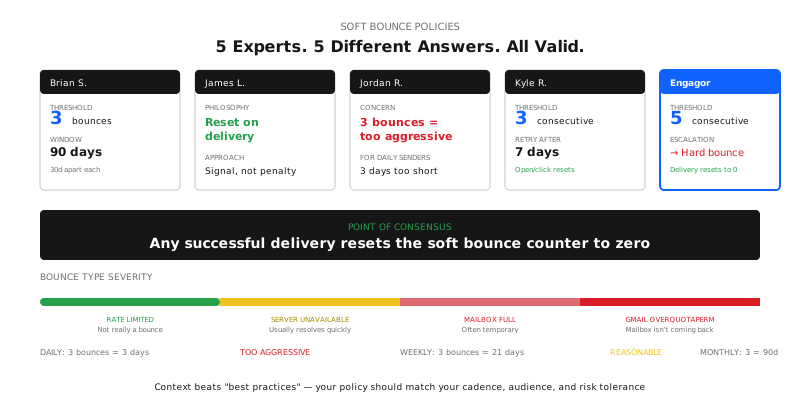
Brian Sisolak: "Generally ESPs set it to something like three soft bounces within at least 30 days of each other. So 90 days total. Really depends on your email cadence."
James Lamb: "I think if you are delivered (not bounced) you should reset to zero. You're looking for signals of a problem, not a three strikes penalty."
Jordan Rubenstein: "With daily sends, suppressing after 3 soft bounces may be too aggressive — 3 days may not be enough time for something transient to resolve."
Kyle Renfrow: "We mark somebody temporary invalid on a mailbox full for 7 days, then retry. After 3 consecutive temp invalids you'll go invalid, but any open/click resets the count back to 0."
Our take at Engagor: 5 consecutive soft bounces escalates to hard bounce, with a reset-to-zero as soon as one email is delivered successfully.
Five experts. Five different policies. All of them valid.
Why There's No Standard (And Why That's Fine)
Laura Atkins from Word to the Wise — one of the most respected voices in email deliverability — cut straight to the heart of the issue:
"Bounce handling is such a mess. 'Transient' and 'permanent' in the SMTP transaction is about what to do with the message currently being attempted. It is, inherently, a stateless transaction. 'Hard' and 'soft' are terms with so many definitions they may as well not have any definitions."
That's worth reading twice.
The SMTP protocol wasn't designed to tell you what to do with future emails. A 5xx code means "don't retry THIS message." It says nothing about whether the address will work tomorrow.
The industry bolted on "hard" and "soft" classifications later, but there was never a formal standard. Laura again:
"25 years ago some folks got together and created a 'standard' but it was 7 people in a room and the vast majority of them are not in email any longer."
The Only Point of Consensus: Reset on Success
Across all the different policies, one principle emerged that everyone agreed on:
Any successful delivery should reset your soft bounce counter to zero.
As James Lamb put it: "You're looking for signals of a problem, not a three strikes penalty."
This reframe is important. You're not punishing subscribers for past bounces. You're identifying addresses that consistently fail to receive mail. The moment mail gets through, the "signal" disappears.
Not All "Mailbox Full" Is Equal
Here's where it gets technically interesting. The original question mentioned Gmail accounts with full mailboxes. Laura pointed out something most senders don't realize:
"Gmail gives two separate 'mailbox full' responses — one is a 5xx where they don't think the mailbox is ever going to empty, and the other is a 4xx where they think the mailbox will be empty."
Look at these actual bounce responses from Amazon SES:
Gmail (classified as soft bounce by SES):
552-5.2.2 The recipient's inbox is out of storage space and inactive. Please
552-5.2.2 direct the recipient to
552 5.2.2 https://support.google.com/mail/?p=OverQuotaPerm
Notice that "OverQuotaPerm" at the end? And "inactive"? Laura's take: this might actually be miscategorized as a soft bounce. Gmail is telling you this mailbox isn't coming back.
Compare that to a truly transient bounce where the user just needs to delete some emails.
Your ESP may not be making this distinction. And that matters for your policy.
A Framework, Not a Rule
Given the lack of industry consensus, here's how to think about building YOUR soft bounce policy:
Factor 1: Your Email Cadence
| Cadence | Consideration |
|---|---|
| Daily | 3 soft bounces = 3 days. Too aggressive. Consider 5-7 bounces or add a time window. |
| Weekly | 3 soft bounces = 3 weeks. More reasonable, but still consider the time gap between bounces. |
| Monthly | 3 soft bounces = 3 months. Probably fine as-is. |
Factor 2: Time Window Between Bounces
A soft bounce from 2018 shouldn't count the same as one from last week. Consider:
- Only counting bounces within a rolling 30-90 day window
- Weighting recent bounces more heavily
- Requiring bounces to be "consecutive" (no successful delivery between them)
Factor 3: Bounce Type
Not all soft bounces are equal:
- Mailbox full: Often temporary, worth retrying
- Server temporarily unavailable: Usually resolves quickly
- Content rejected: Nothing wrong with the address — it's your content
- Rate limited/deferred: Not a bounce at all, really
Factor 4: Your Risk Tolerance
| Priority | Policy Leans Toward |
|---|---|
| Maximum reach | More lenient — keep addresses longer, risk some reputation impact |
| Maximum reputation | More aggressive — remove faster, lose some valid subscribers |
There's no right answer. Only trade-offs.
Practical Recommendations
Based on the collective wisdom from the Email Geeks discussion:
-
Always reset on success. Any delivered email (or better: any open/click) resets the bounce count to zero.
-
Use consecutive bounces, not cumulative. "5 consecutive soft bounces" is more meaningful than "5 soft bounces ever."
-
Match your threshold to your cadence. Daily senders need higher thresholds than monthly senders.
-
Add a time component. "3 soft bounces within 30 days" is smarter than just "3 soft bounces."
-
Inspect the actual bounce message when possible. ESPs categorize bounces differently. The raw SMTP response often tells a clearer story.
-
Review periodically. As Kyle mentioned: "I'll look at the data a few times a year and if there are emails who soft bounce more than 90% of the time but every once in a while get an email through, I remove them."
The Bottom Line
There is no industry standard for soft bounce handling. The SMTP protocol doesn't define one. ESPs all implement it differently. And the experts who live and breathe this stuff every day all have different policies.
That's not a failure of the industry. It's an acknowledgment that context matters.
Your soft bounce policy should reflect your email cadence, your audience, your risk tolerance, and your willingness to inspect the data regularly.
The only truly wrong approach? Set a rule once and never look at it again.
Contributors
This post features insights from industry experts who generously shared their knowledge:
Thank you for contributing to this discussion in the Email Geeks community.
Engagor automatically monitors bounce patterns and deliverability signals across every ESP and MTA — so you're not relying on a rule you set once and forgot. View pricing →