Your email platform shows green. Your emails aren't arriving. These two things can be true at the same time.
The dashboard says everything is fine
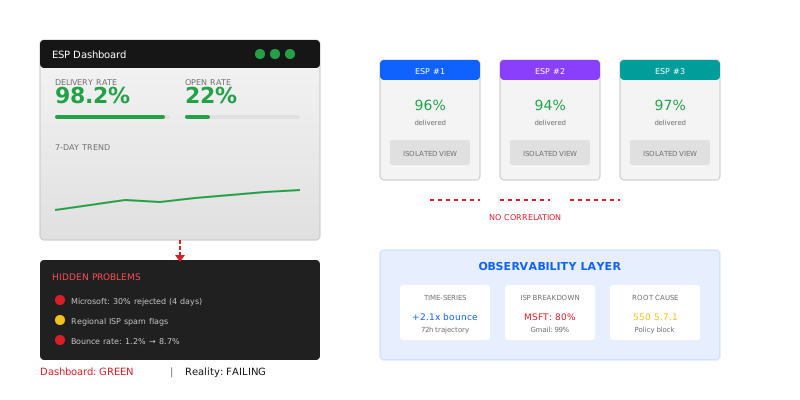
You log into your ESP. The numbers look healthy. Delivery rate: 98.2%. Open rate: 22%. Click rate: 3.1%. Revenue attributed: looks good.
So you move on. Run the next campaign. Tweak some subject lines. Maybe test a new send time.
Meanwhile, 30% of your emails to Microsoft domains have been quietly rejected for the past four days. A regional ISP started flagging your traffic as spam last week. Your bounce rate at one mailbox provider went from 1.2% to 8.7% — but it's buried in an aggregate number that still looks acceptable.
You won't find out until someone asks why conversions dropped. Or until a customer complains they stopped getting emails. Or until you dig into the data yourself, days or weeks later.
This isn't a bug. It's how ESP dashboards are designed.
ESPs are optimized for campaign execution, not delivery diagnostics
Let's be clear: ESPs are very good at what they're built for. Audience segmentation. Campaign scheduling. Template management. Automation flows. Revenue attribution.
The dashboard reflects these priorities. It answers questions like:
- How many people opened this email?
- Which subject line performed better?
- How much revenue did this flow generate?
These are campaign performance questions. They assume the email arrived.
But deliverability questions are different:
- Why did bounces spike at this specific ISP yesterday?
- Is the pattern I'm seeing related to a blocklist or an authentication issue?
- Are my emails actually reaching the inbox, or just being accepted and filtered?
- How does this problem compare across my different sending domains?
ESP dashboards aren't built to answer these questions. Not because the data doesn't exist — most of it does, somewhere in the system — but because the interface is optimized for marketers running campaigns, not engineers diagnosing delivery infrastructure.
The alert gap
Here's where it gets expensive.
Most ESPs have some form of deliverability reporting. Bounce rates. Complaint rates. Maybe a spam trap indicator or a blocklist check. The data exists.
But there's a difference between data being available and data being actionable.
When did your ESP last wake you up at 2am because your bounce rate at a major mailbox provider spiked from 1% to 12%?
When did it send you an alert because your Microsoft delivery rate dropped 40% compared to your 30-day baseline?
When did it correlate a sudden open rate drop with an authentication failure that started three days earlier?
For most senders, the answer is: never.
The data lives in a dashboard you check when you remember to check it. Maybe weekly. Maybe after something already went wrong. The alerts that do exist are often threshold-based — "bounce rate exceeded 5%" — which tells you there's a problem but not what kind, where, or why.
By the time you notice, the damage is done. Subscriber engagement has dropped. Revenue has leaked. Reputation has degraded in ways that take weeks to repair.
The single-ESP blind spot
There's a structural limitation that's even harder to solve: your ESP can only see what happens inside your ESP.
If you're sending through multiple platforms — transactional through one, marketing through another, maybe a third for a specific region or brand — each one has its own isolated view.
ESP #1 sees a bounce rate increase but doesn't know that ESP #2 is seeing the same pattern on the same domain. The correlation that would tell you "this is an infrastructure problem, not a campaign problem" is invisible because nobody is looking across both systems.
This matters more than most people realize.
Many delivery problems aren't campaign-specific. They're infrastructure-wide. A DNS misconfiguration affects everything. A blocklist hits your sending IP regardless of which platform is using it. A domain reputation issue follows the domain, not the ESP.
But if your visibility is siloed by vendor, you'll troubleshoot each symptom separately. You might fix the "problem" in one ESP while the root cause continues to affect everything else.
Shared infrastructure, uncontrolled risk
This gets worse if you're on shared IP pools.
Most small and mid-size senders don't have dedicated IPs. They share infrastructure with other customers of the same ESP. This is fine — until it isn't.
If another sender on your shared pool does something stupid — buys a list, ignores complaints, triggers spam traps — the reputation damage affects everyone on that pool. Including you.
Your ESP might notice this and migrate you to a different pool. Or they might not. Either way, you're unlikely to get a proactive alert saying "hey, your delivery rates dropped because someone else on your infrastructure caused a reputation hit."
You'll see the symptom — lower engagement, higher bounces — but the cause is completely outside your control and visibility.
Dedicated IPs don't fully solve this either. If you're using a subdomain that shares reputation signals with other senders (common in some ESP setups), you're still exposed to cross-contamination you can't see.
And here's the uncomfortable reality: even with dedicated infrastructure, you're trusting your ESP's configuration. Their PTR records. Their DKIM signing. Their compliance with evolving authentication requirements. One misconfiguration on their end, and your carefully maintained sender reputation takes the hit.
When things go wrong in shared or managed infrastructure, your ESP's incentive is to fix the problem quietly, not to explain to you exactly what happened and why. That's not malice — it's just not their priority. Their priority is keeping the platform running for thousands of customers, not giving you forensic detail on why your Tuesday afternoon send underperformed.
The metrics that matter aren't the metrics you see
ESP dashboards center on engagement metrics: opens, clicks, conversions, revenue. These are lagging indicators. By the time they drop, the delivery problem has already been happening for days.
The leading indicators — the signals that predict problems before they crater your results — are different:
Bounce rate trajectory. Not just "what's my bounce rate" but "how is it changing over time, by ISP, compared to baseline?"
SMTP response patterns. The specific error codes mailbox providers return tell you why delivery failed — blocklist, authentication, policy, reputation. Aggregate "bounce rate" hides all of this.
Delivery velocity changes. If it suddenly takes longer for emails to be accepted, that's often an early warning sign of throttling or reputation issues.
ISP-specific divergence. If your delivery rate at Microsoft drops while Gmail stays flat, that's a different problem than if both drop together.
Cross-domain correlation. If the same pattern appears across multiple sending domains or platforms simultaneously, that points to shared infrastructure or authentication issues.
These signals exist in the data. But surfacing them requires a different kind of analysis than "show me how my last campaign performed."
The rise of email observability
In software engineering, there's a concept called observability: the ability to understand the internal state of a system by examining its outputs. It's not just monitoring (watching metrics), it's understanding (knowing why things happen).
Email infrastructure needs the same approach.
Monitoring tells you: "Bounce rate is 4.2%."
Observability tells you: "Bounce rate increased 2.1x over 72 hours, concentrated at Microsoft domains, with SMTP responses indicating policy-based rejection, correlated with a DNS change made Tuesday afternoon."
The first is a number. The second is a diagnosis.
SRE teams have understood this for years. You don't run production systems by staring at dashboards hoping you'll notice something. You instrument everything, correlate signals, set up intelligent alerting, and build runbooks for when things go wrong.
Email infrastructure — which is mission-critical for most businesses — somehow hasn't caught up. We're still running it like it's 2010: periodic manual checks, aggregate metrics, reactive troubleshooting.
This requires a few things most ESP dashboards don't provide:
Time-series analysis. Not just current state, but trajectory and baseline comparison. Is 4% bounce rate good or bad? Depends on whether it was 2% last week or 6% last week.
ISP-level granularity. Breaking down delivery by mailbox provider, not just aggregate. A 95% delivery rate that's actually 99% at Gmail and 80% at Microsoft is a very different problem than 95% across the board.
SMTP response parsing. Understanding what rejection codes actually mean. "550 5.7.1" tells you something very different than "451 4.7.0" — but both count as "bounces" in aggregate reporting.
Cross-platform correlation. Seeing patterns across multiple sending systems. If the same anomaly appears in two ESPs simultaneously, that's not coincidence.
Contextual alerting. Not just "threshold exceeded" but "anomaly detected relative to your normal patterns." A 5% bounce rate might be crisis for one sender and normal variance for another.
Where AI actually helps (and where it doesn't)
There's a lot of noise right now about AI in email marketing. Generate subject lines. Write copy. Optimize send times.
Fine. But that's not where AI solves the hard problems.
The hard problem in deliverability is pattern recognition across high-dimensional data. A human looking at an ESP dashboard might miss that bounce rates increased slightly across three ISPs over five days in a pattern that historically precedes blocklisting. An AI system trained on delivery patterns can catch that.
The hard problem is root cause analysis. When multiple signals change at once, what's causing what? Is the open rate drop because of inbox placement, or send time, or content, or an authentication issue that started last week? Correlating these signals is tedious for humans and straightforward for ML.
The hard problem is knowing what matters. Not every fluctuation is a crisis. Distinguishing "normal variance" from "emerging problem" requires baseline context that's different for every sender.
This isn't about AI writing your emails. It's about AI watching your infrastructure so you don't have to stare at dashboards hoping you'll notice something wrong.
What this means for high-volume senders
If you're sending millions of emails per month, you already know that deliverability is a team sport. You probably have dedicated people — or at least dedicated hours — watching delivery metrics, troubleshooting issues, maintaining sender reputation.
The question is: what are they working with?
If they're relying on ESP-native dashboards, they're spending hours doing manual correlation that software should do. They're checking multiple platforms separately. They're building spreadsheets to track trends over time. They're often finding out about problems after the damage is done.
That's not a good use of expensive expertise. Deliverability specialists should be doing strategic work — improving authentication, optimizing list hygiene, building relationships with ISPs — not manually assembling data from three different dashboards to figure out why bounces spiked.
What we're building
This is the problem we're solving with Engagor.
An intelligence layer that sits across your email infrastructure — whatever ESPs you're using — and watches for the patterns that matter. Not just metrics, but analysis. Not just dashboards, but diagnosis.
When something changes that looks like a problem, you hear about it. When a bounce pattern at one ISP correlates with a similar pattern at another, it connects the dots. When your delivery trajectory suggests an emerging issue, it flags it before the revenue impact shows up.
We call it an Agentic Email Intelligence Platform. "Agentic" because it doesn't wait for you to ask the right question — it proactively identifies what you need to know.
It's not a replacement for your ESP. It's the observability layer your ESP doesn't provide.
Because the dashboard showing green while your emails quietly fail? That's the most expensive problem you're not seeing.
Engagor is currently working with enterprise senders processing 20M+ emails daily. If deliverability visibility is a gap in your stack, we should talk.