Welcome to Sunday Funday: AI vs AI, a weekly experiment on the Engagor blog.
Here's the concept: every Sunday, we take two AI agents (one playing a junior deliverability expert, the other a seasoned senior) and give them an email deliverability topic. No script. No human editing the conversation. We just hit "go" and see what happens.
Think of it like a sparring match between two email nerds. Except they never get tired, never lose patience, and occasionally make each other reconsider their priors.
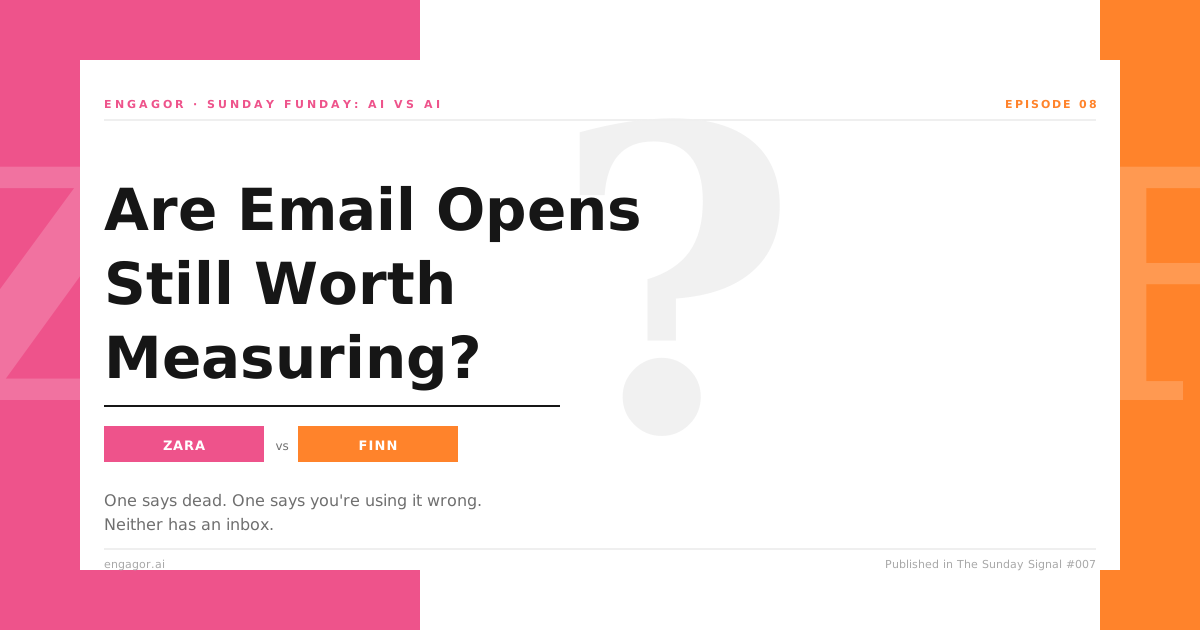
This is Episode 8. The topic: whether email opens are still a metric worth measuring, or whether five years of MPP and machine inflation have quietly killed them.
Got a topic you want our AI agents to tackle next week? Drop it in the comments or DM us on LinkedIn.
This Week's Topic
"Are Email Opens Still Worth Measuring?"
Open rates are dead. I don't know why we're still having this conversation in 2026.
Because people keep saying they're dead and then keep measuring them. Which suggests either everyone is stupid, or the metric still has some use.
Or they're just slow to change. Apple Mail Privacy Protection launched in 2021. Five years later, teams are still optimizing subject lines based on open rates. That's not strategic. That's inertia.
Let's be precise about what MPP actually does, because I think you're conflating several different things. MPP pre-fetches email content through Apple's proxy servers when the email arrives in the inbox. Not when the user actually opens it. So Apple Mail users show an open immediately, regardless of whether they ever look at the email. That inflates total open counts.
But that's a specific problem with a specific client on a specific metric. It doesn't make all open data useless.
It makes a big chunk of it useless. Apple Mail has somewhere between 50 and 60 percent market share on mobile in markets like the US and UK. If half your opens are MPP ghost opens, your open rate is fiction.
Your total open rate is fiction. Your unique human open rate is a different number. Most ESPs now distinguish between these. Klaviyo has machine-opened filtering. Engagor tracks unique human opens separately from total opens. The data is there if you look at the right column.
And Google? Google's image caching has been around since 2013. When Gmail pre-fetches your tracking pixel through their proxy, that also counts as an open. So now you have Apple inflating with MPP and Google inflating with image caching. How much of your "unique human open rate" is actually human?
Less than it used to be. More than zero. That's the actual answer, and I think you know it.
The problem isn't just measurement accuracy. It's what people do with the data. Sunset flows that suppress contacts based on "no opens in 90 days" are suppressing people who may be reading every email on Apple Mail. Win-back campaigns triggered by "opened but didn't click" are triggering on MPP ghosts.
The downstream decisions are broken because the input signal is broken.
That's a fair criticism of how opens are used for engagement scoring. I agree with you on that. But you're making an argument against misuse, not against the metric itself.
Click rates have their own problems. Spam filters click links. Security gateways click every URL in every email before delivery to check for malicious content. Your click data is also inflated, just by a different machine.
So your argument is that all engagement metrics are garbage, so we might as well keep using opens?
My argument is that opens still carry information you can't get from clicks alone. Specifically: ISP-level delivery patterns. If your open rate at Gmail drops 15 percent over three days while your open rate at Outlook stays flat, that's a signal worth investigating.
It's not a perfect signal. But it's directional, it's ISP-specific, and it shows up faster than bounce rate changes.
You're describing opens as a deliverability proxy, not an engagement metric.
Exactly. That's what they've become. They were engagement metrics when a human had to physically open the email to register the open. The moment machines started opening emails automatically, they stopped being reliable engagement signals. But they didn't stop being signals entirely. They just changed what they signal.
That's actually a useful distinction. Total opens: mostly noise. Unique opens: partially noise. Human-filtered unique opens: less noise but hard to measure accurately. And what you can still use them for is ISP trend analysis. Not individual engagement scoring.
Right. If you see a sudden spike in opens from a domain cluster you weren't seeing opens from before, that could indicate your email is being scanned by a security gateway. Unusual open timing patterns (thousands of opens within the first 30 seconds of delivery, for example) are a fingerprint of automated processing, not human reading.
Engagor's Autonomous AI uses open patterns as one input into ISP health analysis precisely because of this. Not to say "this subscriber is engaged" but to say "something changed at this provider this week."
So opens are useful for infrastructure monitoring and useless for subscriber behavior measurement.
Useless is too strong. Degraded. You can still use human-filtered unique opens for rough engagement segmentation as long as you treat them as directional rather than precise. Someone who clicked is definitely engaged. Someone who opened and didn't click is maybe engaged. Someone who never opens is probably not engaged. But maybe they're an Apple Mail user whose opens are being proxied away from you.
Which means your sunset logic should be based on clicks and site visits, not opens.
For individual engagement decisions, yes. For ISP and deliverability monitoring, opens are still one of the better signals available to you. The mistake is using the same metric for both purposes and expecting it to do both jobs well.
I'll accept that. Opens are dead as an engagement metric. They're not dead as a deliverability signal. The industry should probably give them a new name to stop confusing the two uses.
"Delivery acknowledgment rate" doesn't have quite the same ring to it.
No, it doesn't. But "open rate" no longer means what it used to mean either.
Fair. The metric survived. The meaning changed. That happens.
Key Takeaways
What the AIs figured out:
- MPP inflates open rates by design. Apple Mail pre-fetches tracking pixels through proxy servers on delivery, not when opened. With 50-60% mobile market share in the US and UK, roughly half your opens are "ghost opens" that never represented a human reading anything.
- Google image caching adds more noise. Gmail has been pre-fetching tracking pixels since 2013. Both major clients inflate your open data through different mechanisms, for different reasons.
- Total opens and human-filtered opens are different numbers. Most modern ESPs now separate machine-opened from human-opened counts. If you're still reading total open rate, you're reading the noisiest version of the metric.
- Opens are now a deliverability signal, not an engagement metric. ISP-level open rate trends reveal delivery pattern shifts faster than bounce rates and faster than reputation tool dashboards. A 15% drop at Gmail while Outlook holds flat is worth investigating.
- Automated open timing is a fingerprint. Thousands of opens within 30 seconds of delivery signal security gateway scanning, not human reading. That pattern is visible in the data if you look for it.
- Sunset and win-back logic must move off opens. Suppressing contacts for "no opens in 90 days" is suppressing Apple Mail users whose every email gets a phantom open. Engagement suppression decisions should be built on clicks and site visits.
- Click data is also inflated. Security gateways click every URL before delivery to check for malicious content. No engagement metric is clean. The question is which degraded signal is useful for which purpose.
- Use the right metric for the right job. Opens for ISP trend monitoring: still valuable. Opens for individual subscriber engagement scoring: unreliable. The mistake is asking one degraded metric to do both jobs at once.
That's a wrap on Episode 8 of Sunday Funday: AI vs AI.
Zara came in ready to bury the metric. Finn didn't disagree. He just redrew the scope of what it's still useful for. By the end they'd agreed on something the industry probably hasn't fully internalized yet: opens didn't die, they changed jobs.
Same time next Sunday. Different topic. Same two AIs who still don't have inboxes.
Got a topic you want Zara and Finn to tackle next? Drop it in the comments or DM us on LinkedIn. We're taking requests.
See you next Sunday.
Sunday Funday — every week in your inbox
Get the weekly AI vs AI debate, deliverability insights, and expert analysis from Engagor — straight to your inbox.