My honest take: I'm optimistic. For years, legitimate senders have competed against bad actors who game the system with volume and tricks. Gemini changes that equation. An AI that learns from real engagement will reward marketers who've done the work and bury those who haven't. If this announcement scares you, ask yourself why.
Google just dropped a significant announcement: Gmail is entering the Gemini era.
The headline feature that should matter to every email marketer: AI Inbox.
This isn't another spam filter tweak. It's a fundamental reimagining of how Gmail decides what reaches the top of your subscribers' attention. And I think it's the best thing to happen to email marketing in years.
What Gmail actually announced
Let's cut through the marketing speak.
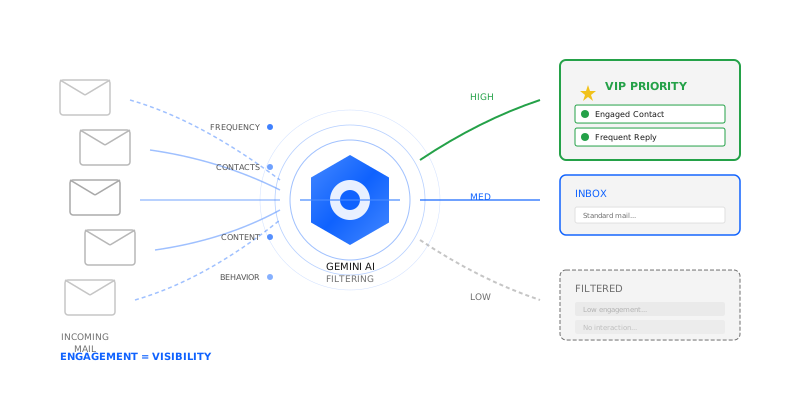
AI Inbox filtering will identify and surface "high-priority" messages while filtering out what Gemini considers noise. The system identifies VIPs based on "people you email frequently, those in your contacts list and relationships it can infer from message content." High-stakes items — bills, appointments, time-sensitive communications — rise to the top.
The rollout starts with "trusted testers" before broader availability in the coming months.
Beyond filtering, Gmail is also launching AI Overviews for thread summaries and natural language search, Help Me Write for AI-assisted composition, Suggested Replies that match your writing style, and Proofread for advanced grammar and tone checking. All powered by Gemini 3.
Why I'm genuinely excited about this
Here's the thing: if your subscribers genuinely want your emails and interact with them, AI will learn that.
Think about what "VIP" signals Gmail is watching. People you email frequently — that's engagement patterns. Those in your contacts list — explicit trust signals. Relationships inferred from message content — genuine interactions, replies, conversations.
If your recipients open your emails, click through, reply occasionally, and don't immediately archive or delete — you're building exactly the relationship signals Gemini will reward.
If you're blasting unengaged lists hoping for scraps... well, good luck. An AI trained on millions of inboxes will see through that faster than any rule-based filter ever could.
I've spent 27 years watching senders try to game filters. For a while, it worked. Subject line tricks, send-time optimization hacks, re-engagement campaigns to people who clearly don't want to hear from you — all of it technically "worked" in the sense that emails landed in inboxes.
But landing in an inbox isn't the same as earning attention. Gmail's Gemini update makes that distinction explicit. Your email might technically be delivered, but if Gemini has learned that this recipient never engages with your content, you're going to the bottom of the pile. Not spam, just... irrelevant.
That's not a threat. That's accountability.
The gap between senders just became a chasm
The divide between "sends email" and "builds relationships" has been growing for years. This accelerates it.
Segmentation matters more than ever. Sending relevant content to subscribers who actually want it has always been best practice. Now it's survival. Spray-and-pray doesn't just hurt your metrics anymore — it actively trains AI to deprioritize you.
Engagement becomes training data. Every open, click, and reply is now feeding Gemini's understanding of who matters to each user. Low engagement doesn't just look bad on your reports. It teaches the algorithm that you're noise.
Genuine value compounds. Content worth reading creates interaction patterns that signal "VIP" to AI filters. Newsletter fluff and promotional noise will quietly disappear into the filtered pile, and your recipients won't even notice it's gone.
What this means for deliverability teams
From a technical standpoint, this announcement doesn't change the fundamentals of getting mail delivered to Gmail. Authentication, reputation, and infrastructure still matter. SPF, DKIM, DMARC — none of that goes away.
But it adds a new layer. Even mail that reaches the inbox may not reach attention.
The inbox is no longer a flat list. It's a curated feed, shaped by AI that's learning from every interaction your subscribers have — with you and everyone else competing for their attention.
This is the natural evolution of what Gmail's Primary/Promotions/Social tabs started over a decade ago. The difference is that Gemini doesn't sort into static categories. It continuously ranks and re-ranks based on observed behavior. Your position in someone's inbox isn't fixed. It's earned, daily, through engagement.
For deliverability professionals, this means the job is expanding. It's no longer enough to ensure mail is delivered. We need to ensure it's valued. Technical reputation still matters, but engagement reputation is becoming equally important.
The marketers who should be worried
Let me be direct about who this hurts.
If you've been buying lists, this is bad news. Gemini will quickly learn that recipients don't engage with senders they never asked to hear from.
If you've been ignoring unsubscribes and soft-bouncing addresses back into your campaigns, this is bad news. The AI will notice the pattern of non-engagement.
If your entire strategy is "send more email to more people and something will stick," this is very bad news. Volume without relevance is exactly what Gemini is designed to filter.
If your open rates are already struggling and your answer has been "better subject lines" instead of "better content for a more engaged list," this is bad news.
But here's the thing: if any of that describes your operation, you were already on borrowed time. Gmail's sender requirements from 2024 started squeezing the low-quality senders. This finishes the job.
The opportunity for everyone else
For marketers who've been doing the work — building genuine relationships, respecting subscriber preferences, sending content worth reading — this is an opportunity.
You've been competing against noise. That noise is about to get filtered out.
You've been investing in engagement while others invested in volume. Engagement is now the ranking signal.
You've been treating email as a relationship channel while others treated it as a broadcast medium. Relationships are exactly what Gemini is learning to recognize.
The AI-powered inbox doesn't care about your send volume or your subject line tricks. It cares about whether recipients actually want to hear from you. And it's going to learn that from behavior, not from what you claim in your sender name or preview text.
What I'd do right now
If I were running an email program today, I'd be asking some hard questions.
What percentage of my list has engaged in the last 90 days? The disengaged portion is about to become invisible in Gmail inboxes.
Am I sending because I have something worth saying, or because it's Tuesday and we always send on Tuesday? Cadence for cadence's sake is going to show up in the data.
If I look honestly at my content, would I want to receive it? Not "is it acceptable" but "is it genuinely valuable?" That's the bar now.
And I'd be running some tests. Tighter segmentation, more personalized content, maybe even reducing frequency to see if engagement rates improve. The old playbook of "more sends = more revenue" may be inverting.
The bottom line
Gmail's Gemini Era isn't a threat. It's a filter.
It will filter out the senders who've been getting by on volume and tricks. It will surface the senders who've earned attention through genuine value.
If you've been doing email right, you're about to be rewarded. If you've been cutting corners, you're about to be exposed.
The future of email marketing isn't about gaming algorithms. It's about earning attention from humans — and now there's an AI watching to verify that you've actually earned it.