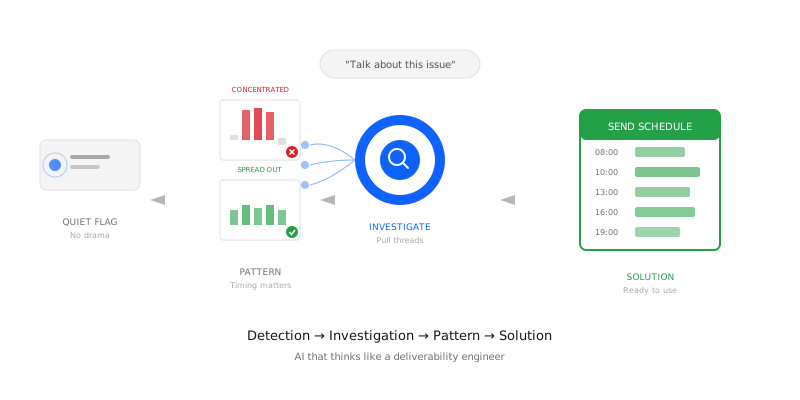
Engagor's AI flagged a critical bounce rate for one sender identity, with 82% of bounces concentrated at Microsoft properties. The root cause was a duplicate header that Gmail ignored and Microsoft rejected.
The Alert
It started with an AI Kanban issue. Engagor's Autonomous AI, running its routine health checks, flagged a critical finding: one sender identity was experiencing a 15.9% bounce rate, with 82.7% of those bounces concentrated at Microsoft properties.
The bounce response was consistent:
550 5.7.515 Access denied, sending domain [domain] doesn't meet the required authentication level.
With authentication details:
Spf=Pass, Dkim=Fail, DMARC=Pass
SPF was passing. DMARC was passing via SPF alignment. But DKIM was failing. And under Microsoft's stricter authentication enforcement in 2026, a DMARC pass via SPF alone is no longer sufficient. Microsoft now requires DKIM to pass independently for high-volume senders.
The AI classified this correctly: authentication failure, Microsoft-specific, critical severity. It recommended an immediate DKIM configuration audit.
Going Deeper with AI Studio
With the issue flagged, we opened AI Studio to investigate. Using natural language queries against the live deliverability data, we could quickly isolate the problem:
"Show me the bounce breakdown for this sender identity by ISP."
The answer was immediate: 2,130 bounces at Microsoft classic properties (outlook.com, hotmail.com), but only 26 bounces at Microsoft 365. And Gmail? Just 59 bounces, all from invalid addresses. Zero authentication failures.
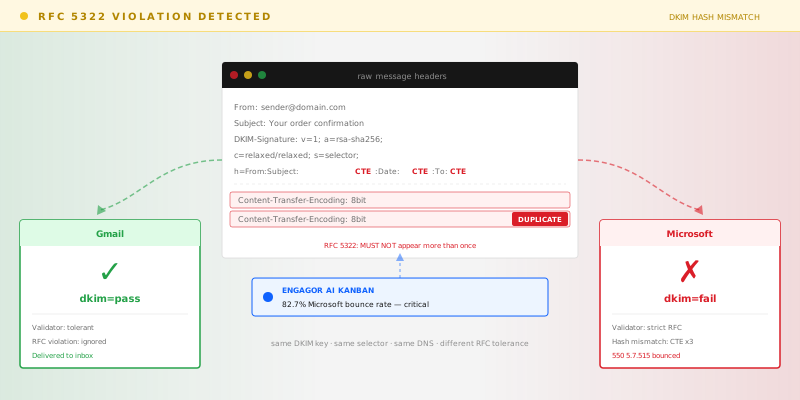
The same DKIM key, the same selector, the same DNS records. Gmail passed it every time. Microsoft rejected it 82% of the time. Something in the message itself was triggering Microsoft's stricter DKIM validator.
The Header Analysis
This is where the investigation moved from platform to protocol. We sent test messages through the same configuration to both Gmail and Microsoft, then compared the raw headers.
Gmail's Authentication-Results:
dkim=pass header.i=@[domain] header.s=[selector]
Microsoft's bounce:
dkim=fail (signature did not verify)
The DKIM signatures were identical. Same algorithm (rsa-sha256), same canonicalization (relaxed/relaxed), same selector, same domain. But there was something unusual in the h= tag — the list of headers included in the DKIM signature:
h=X-GA-CID:From:To:Subject:X-Complaints-To:X-Abuse-To:Content-Transfer-Encoding:Content-Transfer-Encoding:Date:Content-Transfer-Encoding
Content-Transfer-Encoding appeared three times.
And in the message itself:
Content-Transfer-Encoding: 8bit
Content-Transfer-Encoding: 8bit
The header was physically present twice in the message. This is an RFC 5322 violation. Per the spec, Content-Transfer-Encoding must appear exactly once.
Why Gmail Didn't Care
Gmail's DKIM validator is forgiving. It processed the duplicate header references, handled the RFC violation gracefully, and validated the signature without complaint. Google's ARC-Message-Signature even picked up the duplicate references in its own h= tag and processed them correctly.
Microsoft's validator is strict. It enforces RFC compliance more rigorously, and the duplicate header caused a hash mismatch during DKIM verification. The signature was technically invalid because it was computed over a message that violated RFC 5322.
This distinction matters: the issue was not that Microsoft was wrong. The message was non-compliant. Gmail chose to be tolerant, Microsoft chose to enforce. Both are defensible positions, but only one causes your emails to bounce.
Your monitoring stack might have missed this too.
Engagor detected this 82% Microsoft bounce rate, isolated it by ISP, bounce category, and authentication type — automatically, without anyone asking it to look.
The Fix
The root cause was in the sending platform's message composition layer. It was inserting the Content-Transfer-Encoding header twice before passing the message to the MTA for DKIM signing. The MTA then faithfully signed whatever it received, including the duplicate.
Removing the duplicate header from the platform's output fixed everything immediately:
- Gmail:
dkim=pass(as before, nothing changed) - Microsoft:
dkim=pass (signature was verified)withcompauth=passand delivery to inbox
The Microsoft authentication failures for this sender identity dropped to zero. Total time from AI alert to fix: one working day.
What Made This Hard to Find Without AI
Three characteristics made this root cause elusive for traditional monitoring:
Dashboard invisibility. A standard ESP dashboard shows aggregate bounce rates. It would have shown this sender's overall bounce rate rising, but wouldn't have isolated that 82.7% of bounces were Microsoft-specific authentication failures. Engagor's AI broke it down by ISP, by bounce category, and by authentication type automatically.
Validator contradiction. Every external DKIM validation tool said the signature was valid. Because the RFC violation was in the message structure, not in the cryptographic signing itself, standard validators missed it. You had to look at the raw message and count header occurrences manually.
Single-provider manifestation. When a problem only appears at one mailbox provider, the instinct is to blame that provider. "Microsoft is being strict again." Without cross-ISP comparative analysis — which Engagor does automatically — you might waste days waiting for Microsoft to "fix their side" instead of looking at your own message composition.
The Takeaway
Microsoft's stricter authentication enforcement since early 2026 is not just catching senders with missing DKIM records or misconfigured DNS. It is surfacing message composition bugs that have existed for years but never caused visible problems because Gmail and others tolerated them.
If you are seeing intermittent DKIM failures at Microsoft with Spf=Pass, Dkim=Fail, DMARC=Pass, and your DKIM setup validates fine with every external tool, look at the message itself. Check for duplicate headers. Check the h= tag for repeated entries. The answer may not be in your DNS or your key, but in the message your platform is generating.
Engagor's Autonomous AI detected this issue during a routine health check, without any human asking it to look. AI Studio then provided the analytical depth to trace the root cause from a bounce pattern to a specific RFC violation in under an hour. That is the difference between monitoring and intelligence.